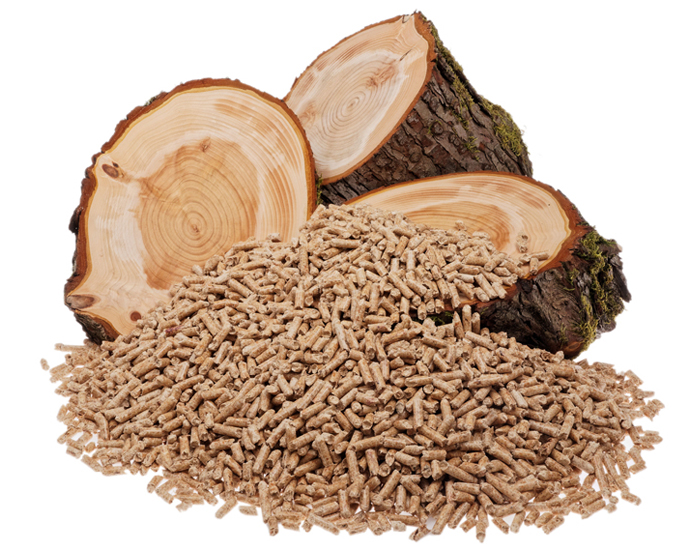
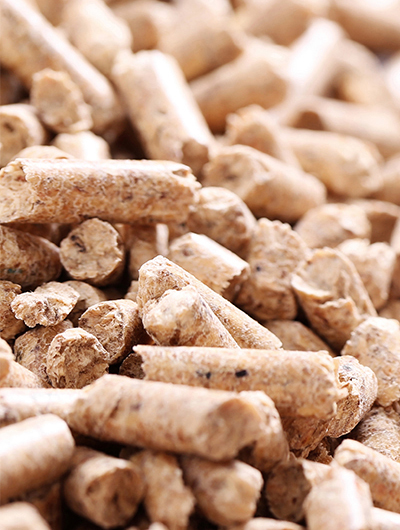
Recycle wood resources such as leftovers from wood manufacturers, furniture factories, sawmills, and pruning residues from forest management and maintenance into sustainable green energy that can be used. After the wood is broken and pulverized into fine powder, solid, short and dense wood particles are formed by high pressure of machinery and equipment.
Wood pellets and coal can generally be burned to generate heat, but wood pellets come from trees. Trees absorb carbon dioxide in the environment during the growth process, and carbon dioxide is released after combustion. For the global environment, there is no new carbon dioxide emissions. And through planned forest management, maintenance and pruning, the trees can grow healthily and play a role in carbon dioxide absorption. Therefore, wood pellets are really a clean and renewable energy that is friendly to the earth's environment.
A conveyor system transports the particles from the warehouse to the pulverizer, where they are pulverized into a fine powder and blown into the power station's boiler. Here, wood pellets are burned as fuel, and the heat from that combustion is used to make steam, which powers a generator that generates electricity.
In addition, the steam generated by the combustion of wood pellets can also be used as one of the heat sources required for chemical, cement, food and other industrial processes.
The density and uniform shape of wood pellets also make them easier to transport and store in bulk. However, they must be kept dry during transport, and when stored in wooden domes, atmospheric conditions must be carefully monitored and controlled to prevent unnecessary burning.
The wood pellets have stable properties, small size, low transportation risk, stable source of raw materials, flame resistance, and good heating energy efficiency. The amount of smoke and dust in the combustion process is small, and the combustion is complete. Burning wood pellets does not contribute to climate change by emitting carbon dioxide or other greenhouse gases. The growth of fibers used to produce pellets absorbs the same amount of carbon that is emitted by burning pellets or decomposing wood in nature; therefore, net CO2 emissions are almost zero.
In the co-firing (Co-firing) method, it is put into a general boiler as a heat source, and it can also be used for biomass power generation. It is expected that the overall social environment will move towards carbon neutrality (reduction of carbon) and then slowly towards net zero (reduction of all greenhouse gas emissions).
When burned, wood pellets produce 80% less CO 2 emissions than coal, as well as lower levels of sulfur, chlorine, and nitrogen.
Global consumption of wood pellets for heating and power generation reached 35 million tonnes in 2018——China is not included.
When used in high-efficiency wood pellet stoves and boilers, wood pellets can provide up to 85% combustion efficiency.

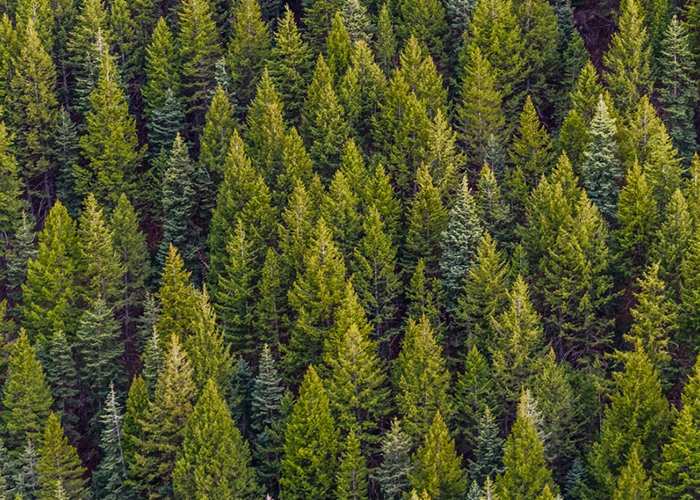
The age of the forest also affects uptake, with young, fast-growing trees absorbing CO2 faster than more mature trees, which already absorb a lot of carbon.
When forests are managed and trees are regenerated naturally or replanted in human timeframes, it makes the wood pellets obtained from them renewable.

Contact number
07-2296898Contact Address
No. 156, Qingnian 1st Road, Xinxing District, Kaohsiung City
